
Naṭajāja, the Lord of Dance and Sanskrit Grammar
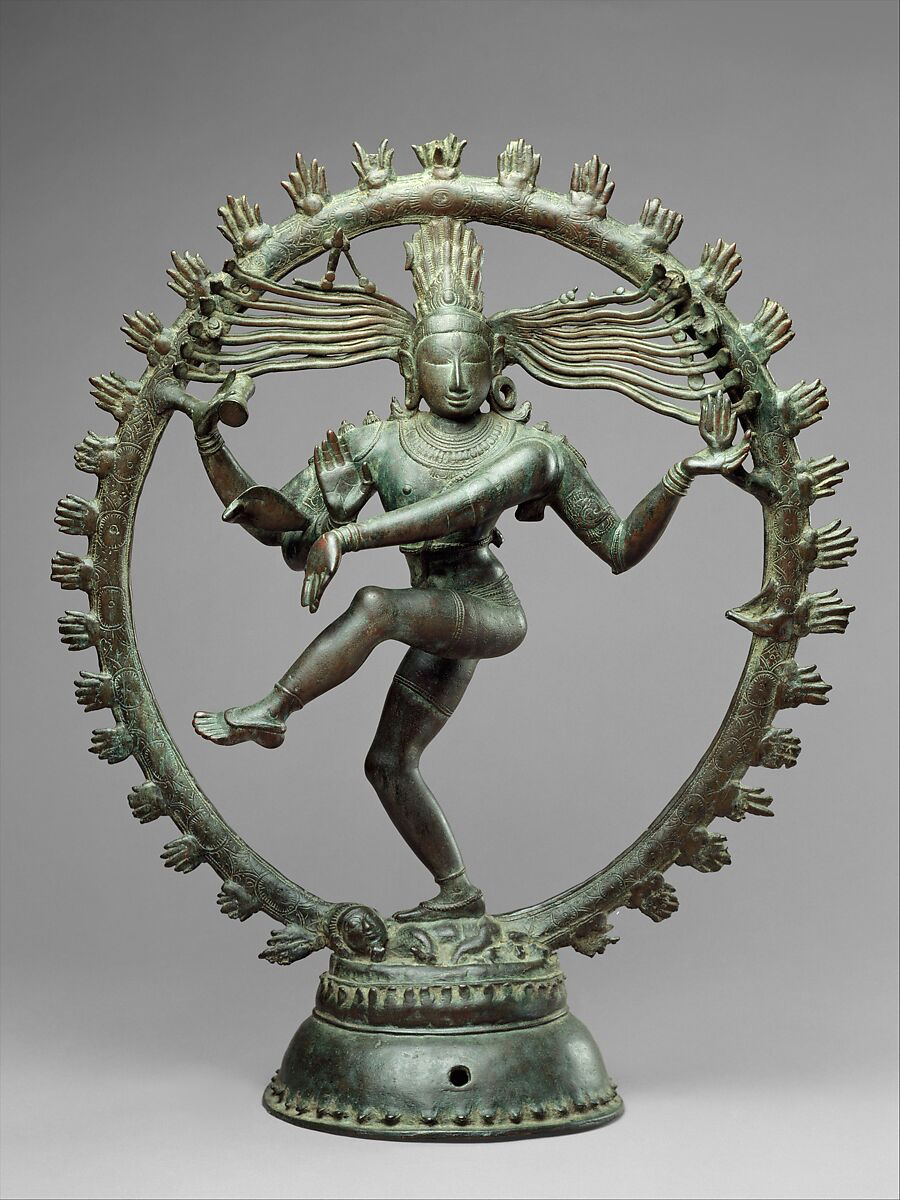
Lord Śiva is usually represented in three forms in temples in India. The sanctum sanctorum in temples holds the ‘formless form’ known as liṅga1. Another form in temples is the icon shown on this web site, known as Dakṣiṇāmūrti (south-facing form). The third form, by far the most well known in the West as it is seen in many a museum, is Natarāja (King among Dancers). An image of this icon is shown above2. There can be no dance without the beat of a drum, and in the image, a drum, is shown in one of Lord Śiva’s right hands. The sound made by this drum has relevance in the Sanskrit grammar system created by Pāṇini.
As is typical regarding authors in ancient India, there is no historic information about Pāṇini. Internal evidence (based on his work) suggests he lived in the sixth or seventh century BCE 3. The rest of what is known about him can best be characterized as legend. One common legend connects him to the Dance of Lord Śiva. According to this legend, Pāṇini wanted to create a grammar system for Sanskrit from the view point of a linguist, covering both secular and Vedic Sanskrit; but he could not figure out how to start this work. Having been raised in a tradition of turning to the Lord when one feels helpless, he prayed to Lord Śiva for guidance. Pāṇini then heard 14 distinct sounds from Śiva’s drum, which he felt were a unique arrangement of the Sanskrit alphabet in fourteen sounds. These fourteen sounds are known as aphorisms of Maheśvara, the cornerstone of his grammar system अष्टाध्यायी, a book of eight chapters.
A verse attributed to Patañjali and often cited on this topic mentions ” . . . the net of Śiva sūtras”:
नृत्तावसाने नटराजराजो ननादडक्कां नवपञ्चवारम्।
उद्धर्र्त्तुकामः सनकादिसिद्धानेतद्विमर्शे शिवसूत्रजालम्॥
Nṛttāvasāne natarājarājo nanāda ḍakkām navapañca vāram
Uddhartukāmaḥ sanakādi siddhānetadvimarśe śivasūtrajālam.
“At the end of the dance, the king among dancers sounded
his drum 14 times. Out of desire to teach Sanaka
and other seekers (how to gain freedom),
he created this net of śivasūtras.”
Note the use of the word śivasūtrajālam, ‘net of sūtras of Śiva’. The word net is appropriate, since this group of fourteen aphorism leads to the capture of the Sanskrit in its entirety in Aṣṭādhyāyī, Book of Eight Chapters, created by Pāṇini.
Pāṇini’s Grammar system and पाणिनीयव्याकरणप्रवेशिका
I mentioned in my last post my plan to publish पाणिनीयव्याकरणप्रवाशिका, Gateway to Pāṇini’s Grammar System, as a new page in this blog. After years of work, I am ready to publish Part I of this book. In three chapters it explains what I consider to be the basics of his system: Chapter 1 – Pāṇini’s Grammar System; Chapter 2 – Phonetics and Fusion Rules; and Chapter 3 – Verbs and Suffixes. Careful review of these chapters is essential to understand the subject matter covered in Part II of this book, namely, the formation of substantives from verbs. I hope you find this work useful.
- The Sanskrit word liṅga is usually translated as phallus in popular English term for the idol! But etymological meaning is quite different. In context, the word means ‘that which is indicated by’, thus the idol Śivaliṅga refers to what it represents, Lord Śiva. ↩︎
- The image here is that of an icon, available in public domain, of a 11th century CE copper casting. This icon is available for viewing in https://www.metmuseum.org/it/art/collection/search/39328. ↩︎
- A Dictionary of Sanskrit Grammar, Kashinath Vasudev Abhyankar and J.M Sukla, Oriental Institute, 1977, Gaikwad’s Oriental Series, No. 134. Page 246 ↩︎